Absa Bank Botswana has paid more to attract deposits, squeezing shareholders’ final profits.
The bank is aggressively turning to new funding tools and fresh income streams to shield investor returns.
Banks work a lot like shops. Instead of selling food or clothes, their “stock” is money. They “buy” it from depositors by paying interest, and then “sell” it to borrowers at a higher price through loans. The difference between the two is how they make money.
In Botswana, there’s been less money moving around because diamond revenues have fallen. Since the government is usually the main source of cash in the financial system, this slowdown has left banks scrambling to find funds. To attract deposits, they’ve had to offer customers better returns on their savings, which raises costs for banks. At the same time, Absa has been cautious about how much it raises lending rates, knowing that pushing them too high could make life even harder for households already weighed down by debt.
A fundamental question that Absa Bank Managing Director (MD) asked was, How can they keep lending at rates customers can afford? This is while protecting shareholders’ margins.
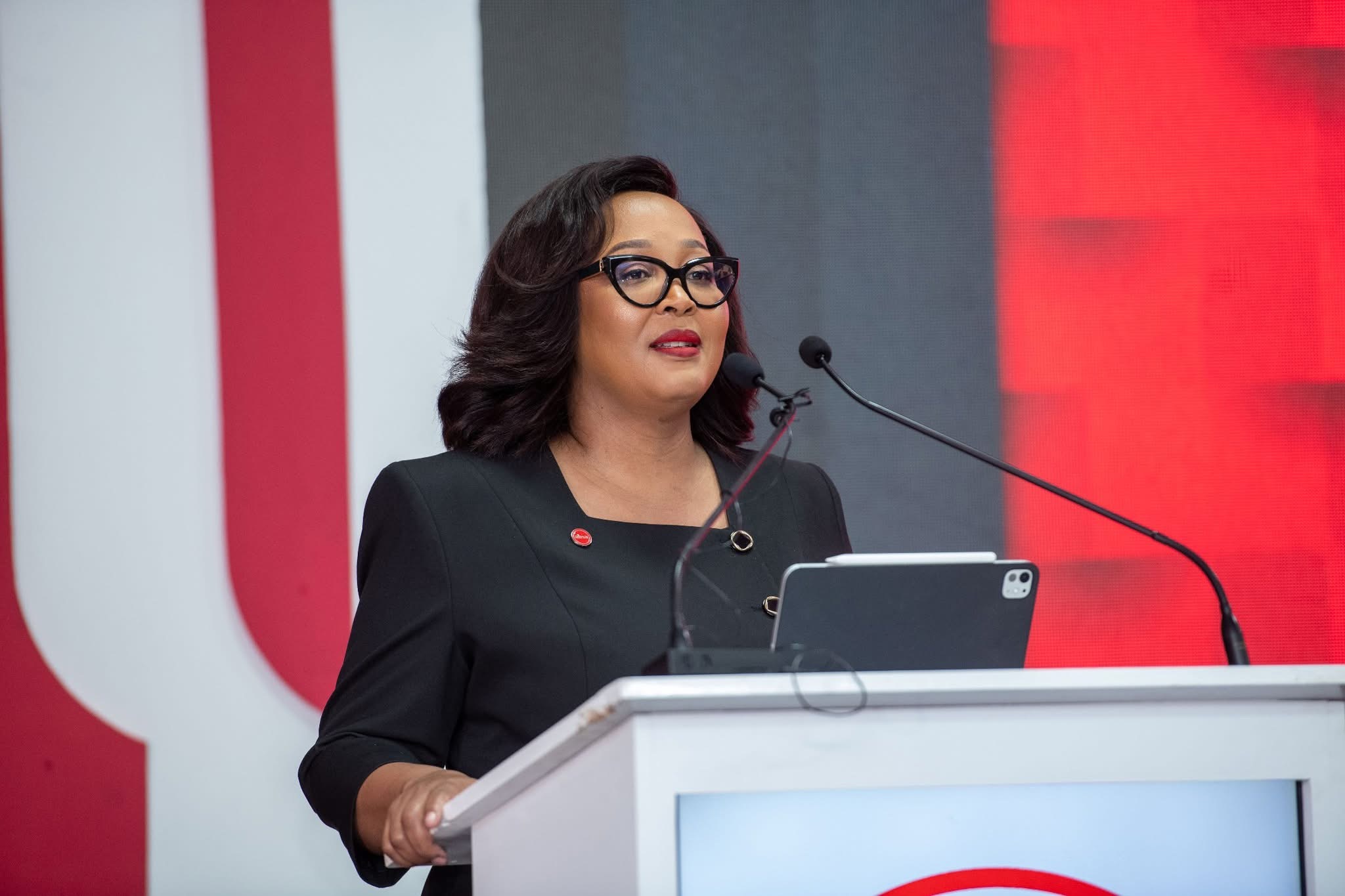
Ms. Keabetswe Pheko-Moshagane framed it plainly.
“As a banking sector, how do we exist to continue to lend at a price that the consumer can afford?”.
she asks
In other words, the current environment is making it harder to make loans without passing higher costs onto borrowers. Banks, including Absa, recently increased their lending rates to protect shareholders’ margins.
Still, the rise hasn’t been enough to cover the higher cost of attracting deposits, the Finance Ministry’s Permanent Secretary recently told Parliament.
Interest on Deposits
In the first half of 2025, Absa earned more from the interest it charges on loans, with income rising 7% to P1.15 billion from P1.07 billion. This growth was supported by a modest 3% increase in total customer deposits to P18.9 billion, driven mainly by retail and business banking clients, whose deposits climbed from P9.8 billion to P11.9 billion. Meanwhile, deposits from the corporate and investment banking segment edged slightly lower, falling from P7.6 billion to P7.56 billion.
However, the cost of holding these deposits also rose. Absa paid 27% more in interest to customers, reaching P396 million compared with P311.9 million a year earlier.
Because of this, the bank’s net interest income—the profit it keeps after paying deposit interest—was slightly lower at P754.8 million, down from P760.7 million. This shows how the bank’s profits are closely tied to the balance between the interest it earns from loans and the cost of funding them. In fact, interest from lending accounts for about 70% of Absa’s total income, underlining that loans remain the engine of the bank’s earnings.
Impact On Profit
“While we’ve absorbed much of the cost pressures relative to the broader environment, this headwind has really contributed to a 27% decline in our profit before tax,”
Ms. Pheko-Moshagane said.
Profit before tax fell to P412.3 million the first half of 2025, down from P562.6 million in the same period last year.
So, How Does The Bank Move Forward?
For Absa, there are essentially paths Ms Pheko-Moshagane highlighted. The first is to find cheaper and more diverse sources of funding.
Treasurer Ms. Salma Baduel explained:
“While government is a large driver of funding in the market, there are other sectors we have looked at where we are not playing, and we have deposit campaigns—some of them running at this point in time.”
She added that retail deposits, the cheaper ones from individuals, have been “quite strong and quite stable.”
For banks, retail deposits are usually cheaper to maintain because the interest paid on them is lower compared to the more expensive corporate and investment banking deposits.
Ms. Baduel highlighted that the key is knowing where the deposits are. “We need to then target where the deposits lie.
But the bank isn’t stopping there.
“There are also other sectors in which we want to play, and that’s what the deposit mobilization focus is on,”
she noted.
Absa is also leaning on its refreshed $2 billion funding programme, which offers various tools to raise money.
It has a large suite of instruments which we can actually tap into. Last year, we did a lot of calling on some of these instruments, allowing us to have a lot of capacity to issue from that new program,”
she said.
At the same time, it is trying new products such as sustainability bonds, which draw funding from international investors.
“If you look at the sustainability bond that we issued, that allows us to tap into external funding through that line,”
Ms. Baduel explained.
And when needed, government support through the repo facility is another option. The other is a strategic pivot mentioned by Ms Pheko-Moshagane, is shifting focus away from traditional lending toward fee-based income, risk management products, and advisory services.
“It’s all about understanding the volatility that you are managing and shifting your strategic levers to respond accordingly,”
she notes.
The short-term outlook is tricky. Ms Pheko-Moshagane expects the industry will feel a dent, but she believes banks can emerge stronger.
“It is important to highlight that we have faced similar challenges in the past, most notably during the COVID era. And we have successfully navigated through that era, emerging stronger with valuable lessons that continue to guide our approach even in the headwinds we are currently facing,”
Ms Pheko-Mosahagane said.
If the pressures drag on, however, a bigger rethink may be needed.
“The environment itself will dictate that it’s a challenge to write assets and liabilities in your business. So, what is your next big thing in that type of environment?”
Here, Ms Pheko-Moshagane believes the advantage of being part of a wider banking group comes into play. Absa operates as a subsidiary of a group present across ten markets.
They have seen volatility in different forms and shapes, and that will leverage the strength of the group to reshape our strategy if things get worse and respond quickly,”
Ms Pheko-Moshagane said.
Related: Absa MD Explains Dividend Pause